

For an app monetized by advertising, the most dangerous number in the dashboard is the ROAS you see in the first weeks after a campaign runs. It is real, it is precise — and it is a fraction of the truth. This is how we built a cohort-level ROAS model for Euronews, the pan-European news app, and why it changed every budget decision that followed.
The results first
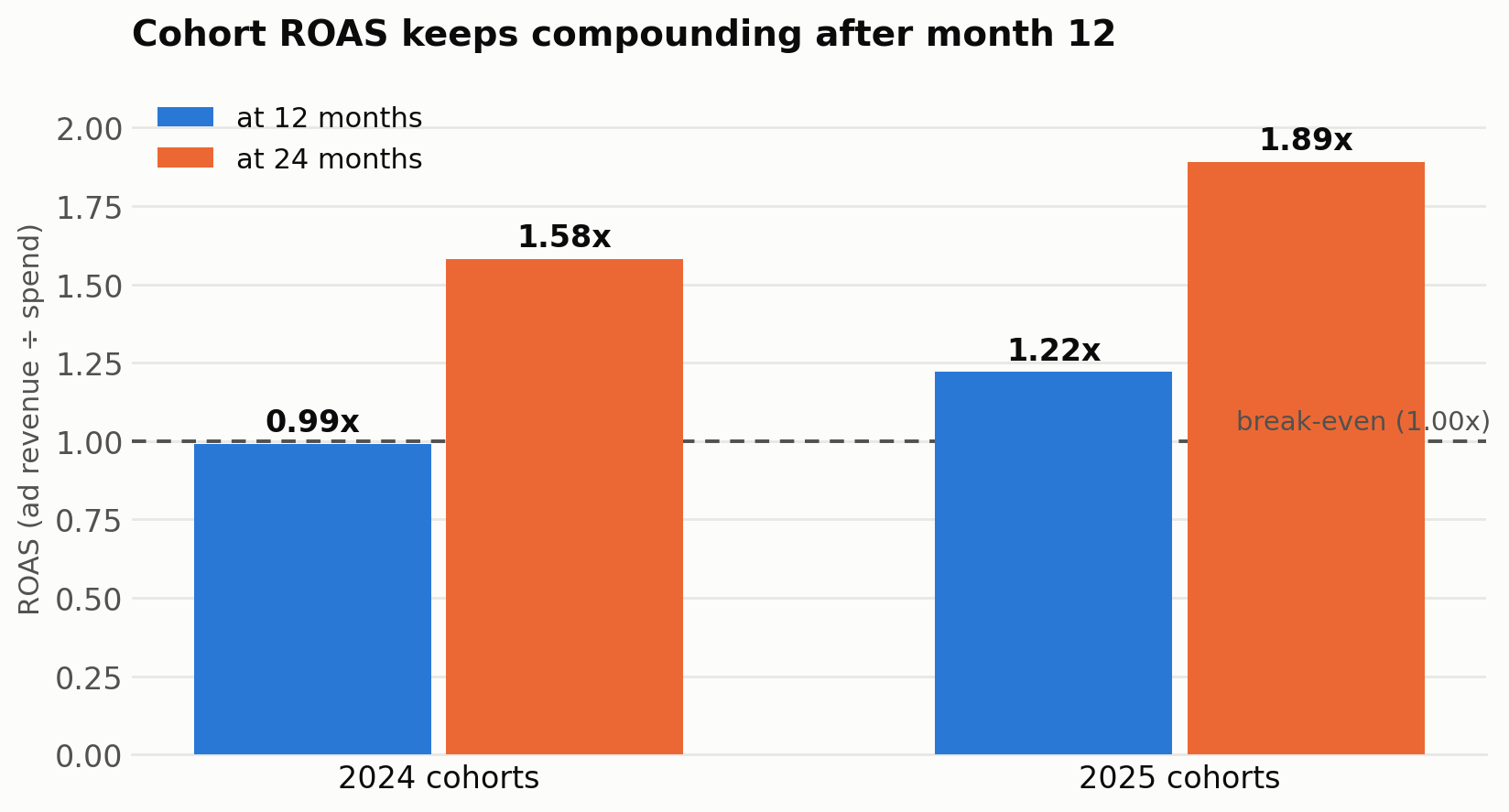
- 2024 install cohorts: 0.99x ROAS at 12 months → 1.58x at 24 months. A year that looked like break-even was, with a second year of ad revenue, comfortably profitable.
- 2025 install cohorts: 1.22x at 12 months → 1.89x at 24 months, with media payback shortening from 12.2 months to 9.2 months year over year.
- Every euro of measured performance came from ad views alone — before any subscription or lifetime value on top.
The problem: ad-funded apps look unprofitable too early
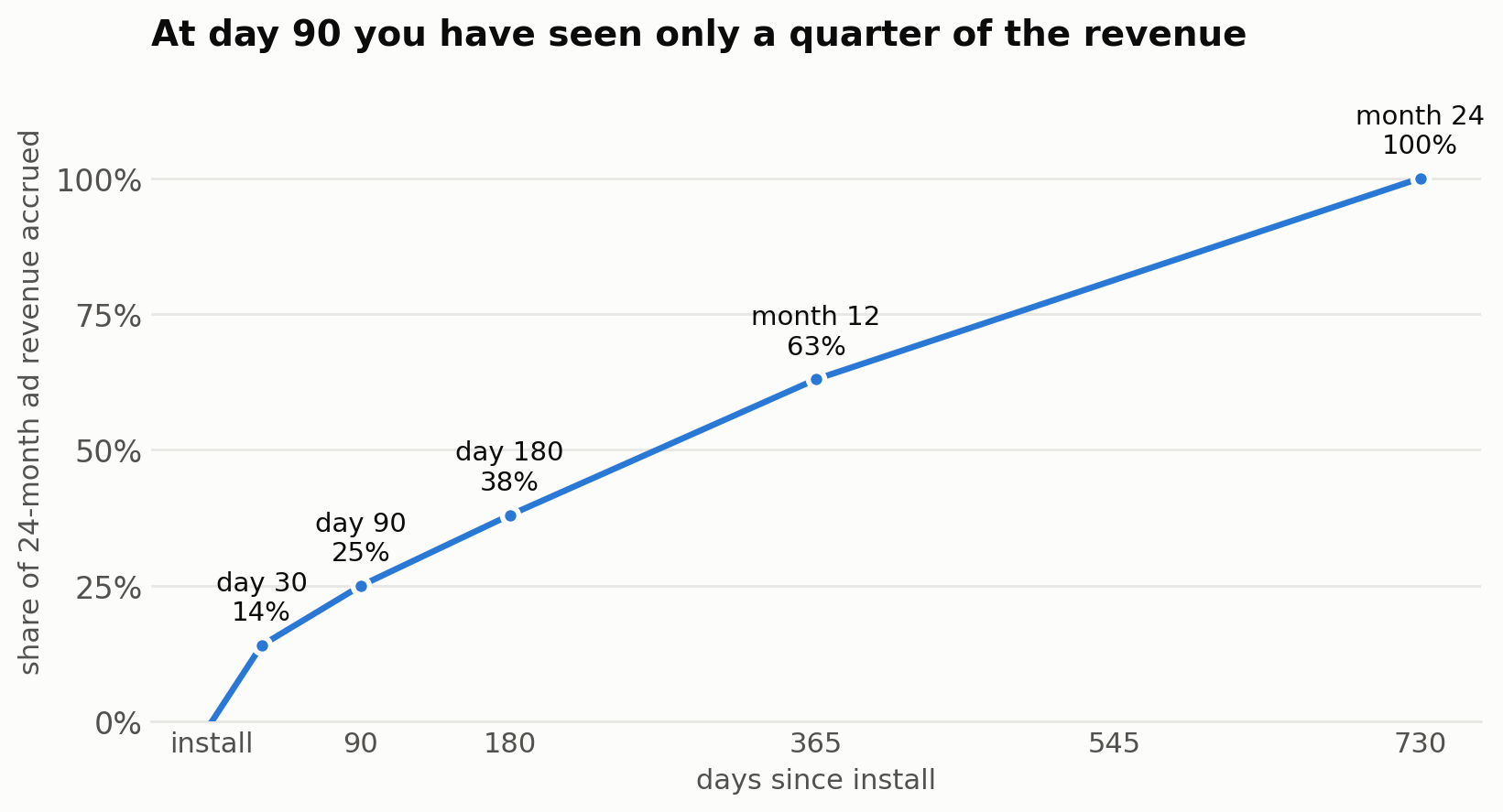
A subscription app earns much of a user's value up front. An ad-monetized news app earns it in thousands of small impressions spread across months of reading. Judged on the standard 7- or 30-day attribution windows, almost every campaign in this account looked like it was losing money — because most of the revenue simply hadn't happened yet.
By day 30, a cohort has generated roughly 14% of what it will earn over two years. By day 90 — the horizon most UA teams optimise on — barely a quarter. Waiting for the truth to arrive on its own means making two years of budget decisions blind. Modeling it means making them early.
What we built
Working from Euronews' attribution data and monetisation rates, we rebuilt performance around the install cohort: every user grouped by the month they installed, every ad view they generate priced at the market rate of the month it occurred, every cohort tracked along its own accrual curve. Three modeling layers made early data decision-grade:
- Maturation multiples. Mature cohorts revealed a stable relationship between early accrual and full-year value. That curve turns a 90-day-old cohort's partial revenue into a defensible 12-month forecast — with the confidence band shrinking every month the cohort ages.
- A 24-month horizon. These users keep watching ads deep into year two, adding roughly 58% on top of first-year revenue. Any ROAS target that stops at month 12 systematically undervalues the channel.
- Attribution-gap corrections. iOS privacy rules hide a large share of paid installs; self-reporting networks stop counting cohort revenue at day 180. Both were modeled explicitly and disclosed as adjustments, not buried.
What the cohort lens revealed

The yearly averages hide the useful information. Across 2025's monthly cohorts, 12-month ROAS ranged from 0.86x to 2.22x — a 2.6x spread inside a single good year. That dispersion is where the strategy lives:
- Country reallocation. Two markets consistently returned multiples of the others at identical install costs, while the largest market absorbed the most budget at break-even. The cohort view made the shift obvious and quantified.
- Scaling with confidence. The strongest cohorts coincided with the account's highest volume — proof the account scaled without efficiency loss, which justified further investment rather than caution.
- Anomaly detection in weeks, not quarters. Because every cohort is read against an expected curve, a tracking misconfiguration surfaced within weeks of appearing — visible as a cohort falling off its curve long before it would have shown in quarterly reporting.
The framework now steers decisions in-flight: new cohorts are read against their expected accrual curves from their first weeks, rather than being judged — and mis-judged — on raw early returns.
Key takeaways
- For ad-monetized apps, early ROAS is not a verdict — it is a data point on a curve.
- Model the curve from your own mature cohorts; industry benchmarks don't survive contact with a specific app's audience.
- Extend the horizon to 24 months — year-two ad revenue is real money that most targets ignore.
- The spread between cohorts, not the average, is where budget decisions come from.
- A cohort model doubles as an early-warning system for tracking breaks and attribution gaps.
FAQ
What is cohort ROAS modeling?
Grouping users by install month and projecting each group's revenue along observed accrual curves, so early partial data becomes a reliable forecast of 12- and 24-month return on ad spend.
Why not judge campaigns on 30-day ROAS?
For ad-monetized apps, a 30-day window captures roughly a seventh of two-year revenue — decisions made on it systematically kill profitable campaigns.
How early can a cohort be read?
With a fitted maturation curve, a directionally useful forecast exists from about day 30, firming meaningfully at day 90 and day 180.
Want your UA measured on what users are actually worth? Talk to Scalebay.
.png)

.png)
.png)



%20(1).png)